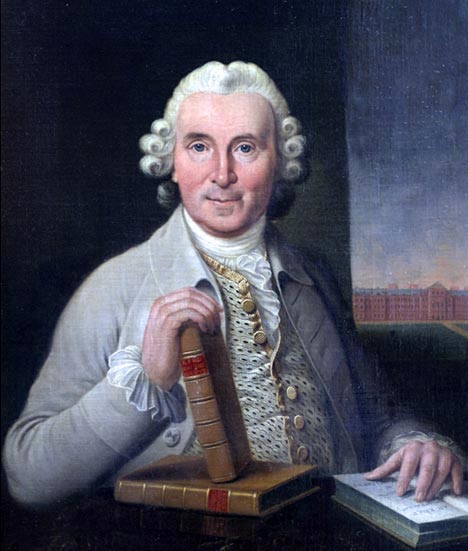
JAMES LIND 1716 – 1794. ‘The Father of Nautical Medicine’.
James Lind entered the Royal Navy as a Surgeon’s mate in 1739 and in 1758 he became Physician-in-charge at Haslar, a post he held for 25 years.
He is probably most well-known for the publication of his ‘Treatise on the Scurvy’. This describes what is believed to be the first clinical trial in the history of medicine. We now know that scurvy is caused by Vitamin C deficiency but at the time the causes of diseases were not understood. Whilst serving as Ships Surgeon on HMS Salisbury in 1747 he conducted experiments to see how effective, or not, different remedies might be. He selected 12 scorbutic sailors and allocated them into 6 groups, all with the same diet, and experimented with a variety of remedies; Cider, Vinegar, Garlic/Mustard seed/Cream of Tartar mixture, Seawater, 2 Oranges and 1 lemon, and Elixir of Vitriol (Sulphuric Acid, spices & alcohol). I think we can guess who survived and was most likely cured.
Lind’s genius recognised that lime juice with sugar and alcohol, as well as a healthy diet of fresh fruit and vegetables was an effective treatment for scurvy. It is incredible that despite Lind’s many publications on scurvy and other diseases, the Admiralty did not implement the findings immediately, although many insightful captains did introduce citrus fruits onto their ships with great effect.
Lind also studied many other medical conditions; infectious diseases, tropical diseases, and digestive illnesses, and was a proponent of hygiene, cleanliness and good ventilation in hospital and in ships at sea. He was a skilled hospital physician in diagnostic, clinical and attempted to improve administrative matters at Haslar – which in the late 1700’s could accommodate 1500 patients and was the biggest hospital complex in Europe at the time.
Lind retired from Haslar in 1783 aged 68, to be succeeded by his son John. He died in 1794 and is buried not in the burial grounds at Haslar as might be expected, but in the churchyard of St Mary’s Portchester.
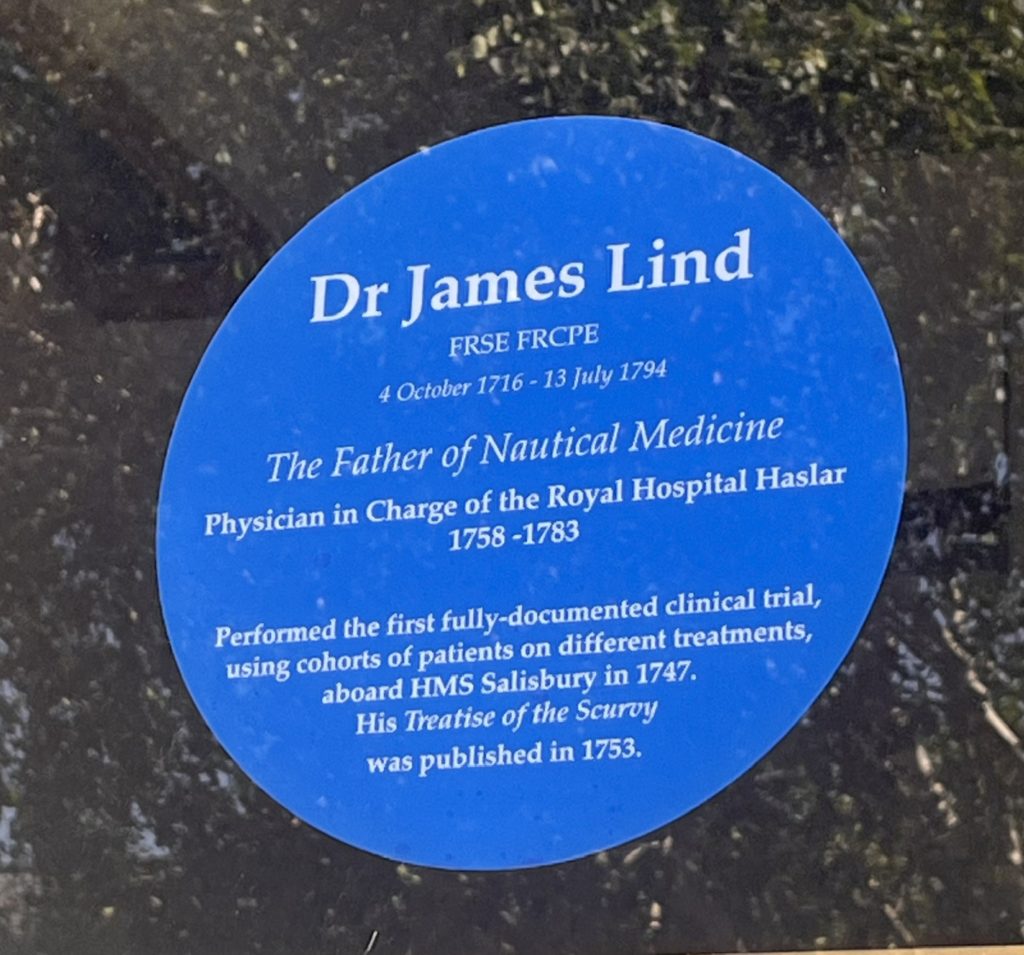
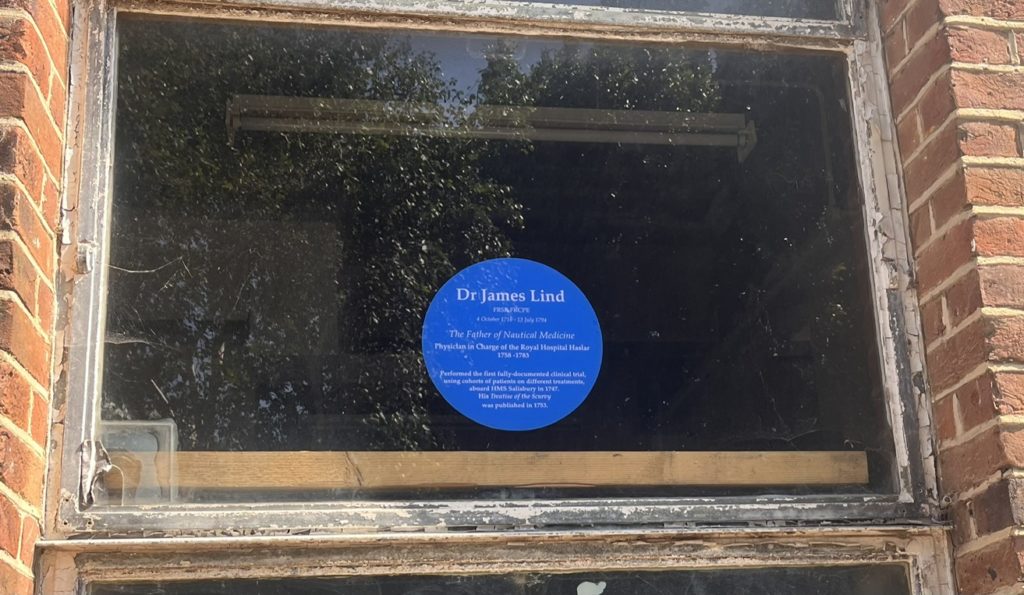
It is believed he lived in one of the Georgian houses at the front of the hospital, and a blue plaque (thanks to the Gosport Society) which commemorates his achievements and his time at Haslar, is to be found in one of the windows of the hospital building opposite. A road in Haslar has also been named as James Lind Avenue in honour of his memory.
His legacy to medicine, naval medicine, the health of sailors at sea and in hospital, and medical research has been described by Professor Ken Shaw as ‘simply exceptional’.
Bibliography
Lind J. A Treatise of the Scurvy. In Three Parts. Containing an Inquiry into the Nature, Causes and Cure, of that Disease. Together with a Critical and Chronological View of what has been Published on the Subject. Edinburgh: Printed by Sands, Murray and Cochran for A Kincaid and A Donaldson, 1753
Lind J. An Essay on the most Effectual Means of Preserving the Health of Seamen in the Royal Navy. 1st ed. 1757 London
The life and legacy of Doctor James Lind. 2019. Professor Ken Shaw. Studio 6, Droxford, Hampshire]
The James Lind Library. www.jameslindlibrary.org
The Wellcome Collection. www.wellcomecollection.org